Occupational Health and Safety Risk Assessment
The Company conducts hazard identification and risk assessments for work activities across all operational processes. The severity and likelihood of potential incidents are evaluated to determine and prioritize risks. Risk assessments are reviewed annually or whenever there are changes in work processes, machinery, or technology, as well as following accidents or near-miss incidents, to ensure that control measures remain appropriate and aligned with changing working conditions.
To effectively identify and assess occupational health and safety risks in the workplace, the Company identifies and prioritizes risks and integrates risk management into its action plans and corporate objectives. This approach aims to control risks while supporting opportunities for the continuous improvement of the Company’s occupational health, safety and working environment management system.
The risk assessment process is as follows:
1). Classification of Work Activities and Areas
The Head of Section / Supervisor, together with department representatives, classifies the work under their responsibility, including relevant activities and work areas. The results are recorded in the designated Work Activities and Areas Classification Form.
2). Hazard Identification
Department representatives review the classified work activities and areas to identify potential hazards associated with each activity. The identified hazards are recorded in the Hazard Identification and Risk Assessment Form (Risk Assessment).
3). Risk Evaluation
Department representatives evaluate the identified hazards to determine the level of risk based on two key criteria: the severity of the hazard and the likelihood of occurrence. The results are recorded in the Hazard Identification and Risk Assessment Form (Risk Assessment).
a. Likelihood
Score
Likelihood
Description
5
Very High
Once a month or more frequently, or highly likely to occur.
4
High
Once every 1–6 months, but no more than 5 times, or likely to occur relatively frequently.
3
Moderate
Once a year, or may occur occasionally.
2
Low
Once every 2–3 years, or may occur only occasionally.
1
Very Low
Once every 5 years.
b. Risk Impact
Severity Level
Severity Rating
Description
5
Very High
- Permanent disability or fatality
- Property damage valued at THB 100,000 or more
- Serious reputational damage to the Company
4
High
- Serious injury resulting in more than 3 days of lost work
- Property damage valued between THB 50,000 and THB 100,000
- Damage to the Company’s reputation
3
Moderate
- Multiple minor injuries requiring medical treatment and 3 days of lost work
- Property damage valued at up to THB 50,000
- Minor reputational damage to the Company
2
Low
- Minor injuries affecting a small number of people, resulting in no more than 3 days of lost work
- Property damage valued at up to THB 10,000
- Minor impact on the Company
1
Very Low
- Psychological impact only, with no physical injury and no associated costs
c. Opportunity Impact
Score
Risk Impact
Description
5
Very High
- Financial impact of more than THB 1,000,000
- May cause immediate disruption to the Company’s operations
- Reputational damage at the national level
4
High
- Financial impact of THB 100,001–1,000,000
- May cause disruption to the Company’s operations within 1 year
- Reputational damage at the provincial level
3
Moderate
- Financial impact of THB 50,001–100,000
- May cause disruption to the Company’s operations within 2–3 years
- Reputational damage at the local/community level
2
Low
- Financial impact of THB 10,000–50,000
- May cause disruption to the Company’s operations within 4–5 years
- Reputational damage within the organization
1
Very Low
- Financial impact of no more than THB 10,000
- No impact on the Company’s operations
- Reputational damage at the departmental level
The risk and opportunity levels are calculated as follows:
- Risk Exposure = Likelihood × Risk Impact
- Opportunity Level = Likelihood × Opportunity Impact
Risks and opportunities related to the Occupational Health and Safety Management System are evaluated according to the following risk classification matrix:
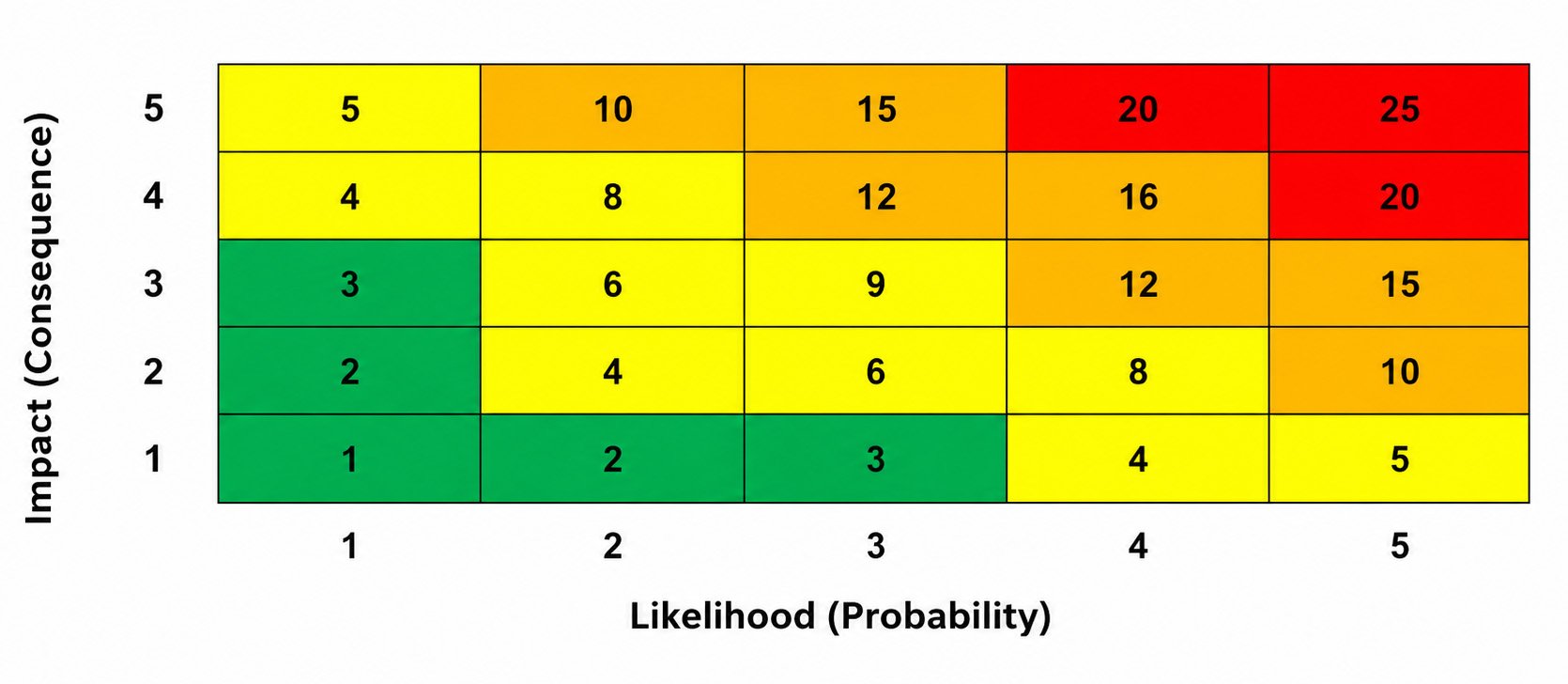
d. Risk Acceptance Criteria
Score
Risk Level
Risk Management
20 - 25
VH : Very High
This risk level is unacceptable and requires immediate risk management. Close monitoring and control are required, or the risk must be reduced as quickly as possible by establishing a Risk Management Plan. Activities that may cause the risk must be suspended until appropriate corrective actions have been implemented.
10 - 16
H : High
This risk level is unacceptable and requires risk management. Close monitoring and control are required, or the risk must be reduced as quickly as possible by establishing a Risk Management Plan.
4 - 9
M : Medium
Appropriate measures shall be established to control the risks associated with the relevant activities.
1 - 3
L : Low
No additional risk control measures are required; however, periodic reviews should be conducted to ensure that existing controls remain effective.
4). Risk Management Based on Assessment Results
The results of the risk assessment are used to determine appropriate risk management actions, taking into consideration the nature of the risk, required investment, and expected benefits. The following risk treatment approaches are applied:
a. Avoid
Actions are taken to avoid activities or events that may give rise to risk. This approach is generally used when the risk is highly severe and cannot be reduced or managed to an acceptable level.
b. Share
All or part of the risk is shared with or transferred to an external party or organization to help assume the risk burden, such as outsourcing certain activities to external service providers.
c. Reduce
Control measures are implemented to reduce the likelihood of a risk event occurring or to minimize its potential impact to an acceptable level. Examples include developing a Contingency Plan, building organizational capabilities, and establishing appropriate operating procedures.
d. Accept
The remaining risk is considered to be within an acceptable level, and no additional action is required to further reduce its likelihood or impact. This approach is generally applied when the cost of additional risk control measures would outweigh the expected benefits.
- Corporate Corporate
- Product & Solution Product & Solution
- Research & Innovation Research & Innovation
- Kumwell Academy Kumwell Academy
- Investor Relations Investor Relations
- Sustainability Sustainability
- Document Downloads Document Downloads
- Distributor Directory Distributor Directory
- Contact Contact
Product & Solution
Investor Relations